Skip to content

Free tool

A punishment ladder your whole staff team applies the same way

Decide once what the first, second and third offence of each kind costs, so two members of staff looking at the same player reach the same answer. Start from a lenient, standard or strict preset, change any step, and copy it out as a table for your staff handbook.

  • Nothing you type leaves your browser
  • Free, with no account

How to use it

Punishment ladder in three steps

  1. 1

    Pick a preset

    Lenient, standard or strict. Every offence gets the ladder for how serious it is, and you can change any of them afterwards.

  2. 2

    Adjust the ones that matter

    Rename an offence, change how serious it is, add, move or remove steps, and leave a note for staff. It tells you if a ladder ever steps down.

  3. 3

    Copy it to your staff

    As a Markdown table for Notion, Google Docs or a wiki, as Discord messages for a staff channel, or as plain text.

Principles

How a fair ladder is built

Most established servers arrive at the same few rules for their ladders, usually after the argument that taught them each one.

1

Every step is heavier than the last

A ladder that steps down tells a player that offending again costs less. The builder warns you when a step is lighter than the one before it, and when a step comes after a permanent ban and can never be reached.

2

How serious it is decides where it starts

A minor offence starts with a warning, a serious one with a ban. Cheating is not on a ladder at all: almost every server bans it permanently the first time.

3

Old offences stop counting

Decide how long an offence counts towards the ladder — ninety days is common — so a player who has changed is not one slip from a permanent ban for something they did last year.

4

The last step repeats

After the last rung, every further offence of that kind gets the last rung again. Say so, or the fifth offence on a four-step ladder becomes a debate.

5

Count each offence on its own ladder

Three different minor offences are usually three first offences, not a third. A pattern across offences is what a staff note and a conversation are for.

6

Leave room for judgement

A ladder is the default, not a cage. Staff can go further for something egregious, as long as they write down why — which is exactly what an appeal will ask.

Why have a ladder at all

Without one, a punishment depends on who answered the ticket. The same VDM is a warning from one moderator and a three-day ban from another, the player notices, and the argument is no longer about what they did. A ladder makes the second offence cost the same whoever is on shift.

It also makes appeals quicker to decide. “This was your third VDM in a month, and the third is a three-day ban” is a sentence anybody on the team can stand behind, and one a player can see coming.

Lenient, standard or strict

Standard is the shape most servers settle on: a warning, a kick, then bans that roughly double — a day, three days, a week — before a permanent ban for the moderate offences that keep happening. Serious offences start at a ban.

Lenient adds a word from staff or a second warning at the bottom, which suits a whitelisted server where everybody was vetted and a mistake is usually a mistake. Strict starts every offence a rung higher and reaches a permanent ban sooner, which suits a public server where most rule breakers are passing through.

Ban lengths that mean something

A ban shorter than a day is often slept through, so most ladders start their bans at one day. After that, doubling — one, three, seven, fourteen, thirty — keeps each step a real step up without a jump from a day to a month.

Write the ban lengths down as days rather than “a short ban”, and use the same lengths across offences. Five offences with five different sets of numbers is a ladder nobody remembers.

A ladder needs a memory

A ladder only works if whoever is on shift can see what a player has already had: the second offence is only the second if somebody knows about the first. That means one record per player, kept whether they come back or not, with every warning, kick and ban on it and who gave each one.

Without that record, a ladder is a spreadsheet nobody updates and a staff channel nobody can search.

With FiveStaff

FiveStaff is the memory your ladder needs

FiveStaff does not choose the step for your staff. It puts the player’s whole history in front of whoever is deciding, so the ladder is applied the same way every time.

  • Every warning, kick and ban on one page

    A player’s history newest first, with who gave each one. Filter it by kind to count the VDM warnings before you choose the next step.

    Players and records
  • Bans until a date, or for good

    A temporary ban ends on the date you set. A lifted ban stays in the player’s history, marked lifted, with the reason.

    Bans and appeals
  • A trust score that moves with the record

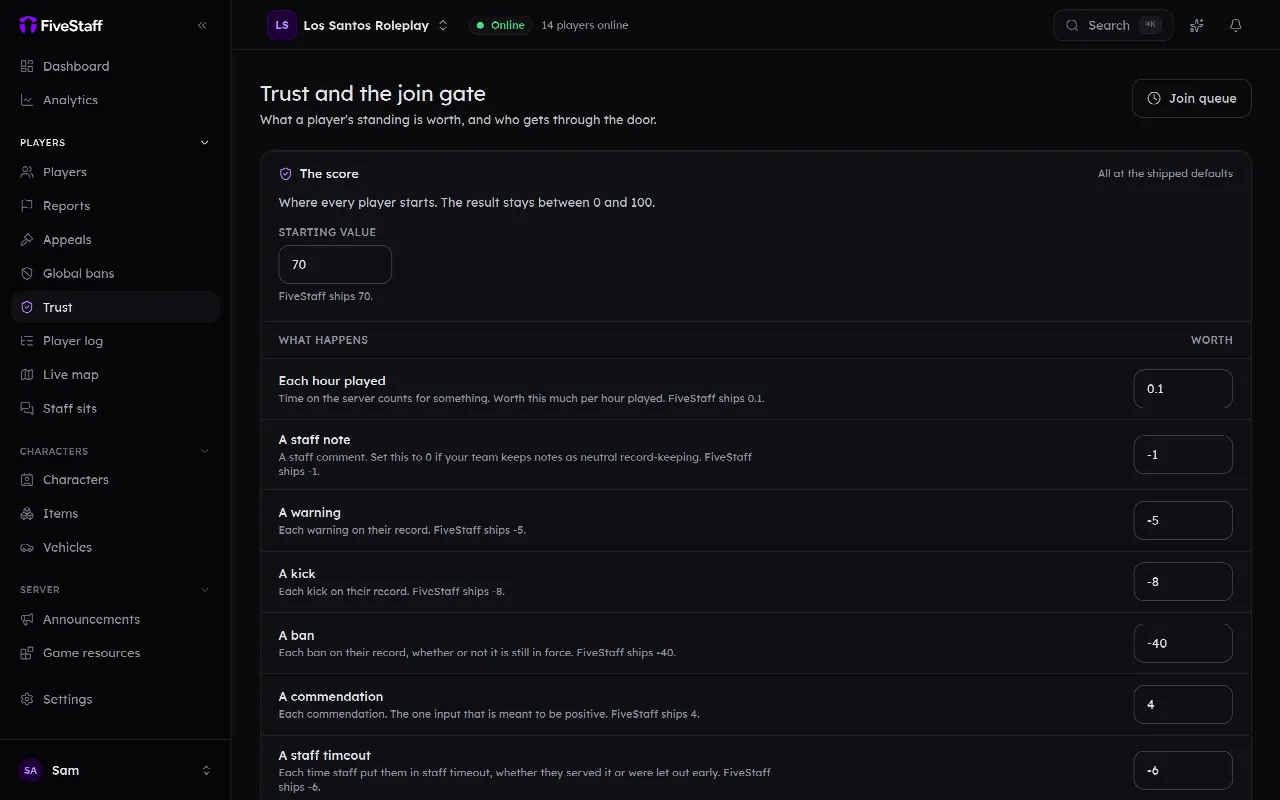
    Warnings, kicks, timeouts and bans lower it and time played raises it, each by a weight you choose, so who needs watching is a number rather than a memory.

    Trust score
  • Appeals your team decides together

    A banned player appeals on a site of its own, and your team reads it beside the ban it is about. Accept, and the ban lifts at once.

    Bans and appeals
  • Every decision on the record

    Every action is written to the audit log with who took it, so “who banned my mate, and why” has an answer.

    Team and permissions
panel.fivestaff.gg
The trust score screen in the FiveStaff panel, with the weight of each warning, kick, timeout and ban
The real panel, from a demo server. Every name in it is invented.

Questions people ask first

How long should a first ban be?

Most servers start at one day for a moderate offence on its third or fourth occurrence, and at three days for a serious offence the first time. Shorter than a day is often slept through.

Should offences expire?

Usually. Ninety days is common: long enough that a pattern shows, short enough that a player who has changed is not punished for last year. Leave cheating and hate out of it.

What about cheaters?

A permanent ban the first time, on every server worth playing on. Ladders are for players you would like to keep.

Does FiveStaff apply the ladder automatically?

No. Your staff choose the step, with the player’s full history and trust score in front of them, and can save each step’s wording as a template. The decision stays with a person, and goes on the record.

How do I share the ladder with my staff?

Copy the table into Notion, Google Docs or any wiki that reads Markdown, or copy the Discord messages into a staff-only channel and pin them.

Put your server on the record

Sign in with Discord, add your server, and drop one resource into it. Free for 3 staff, and nothing to cancel if it is not for you.